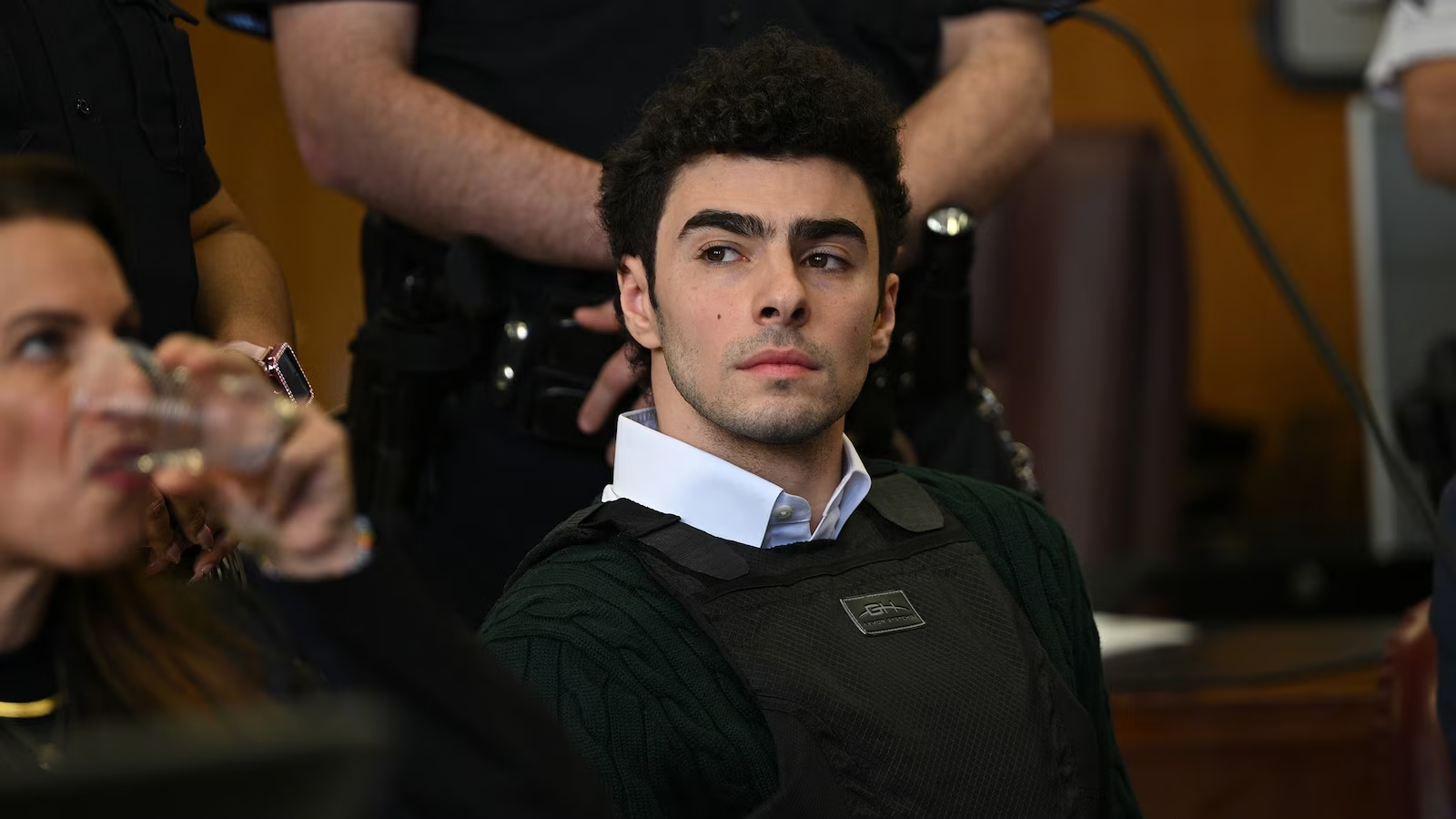
New York, September 16, 2025 — In a major legal ruling today, a New York State judge dismissed two terrorism-related counts against Luigi Mangione in the case involving the December 2024 killing of UnitedHealthcare CEO Brian Thompson. While Mangione still faces several charges, including second-degree murder, the judge found that the evidence did not meet the legal standard required to hold him accountable under the state’s terrorism statutes.
What the Court Ruled
Presiding over the case, Judge Gregory Carro ruled that although Mangione’s actions were clearly premeditated and ideologically charged, the prosecution failed to prove a key element: that Mangione acted with the intent to intimidate or coerce a civilian population or effect governmental policy. Those factors are essential under New York’s definitions of “terrorism” for state charges.
In his decision, Judge Carro noted that while Mangione expressed animus toward UnitedHealthcare and the broader insurance industry, and while symbolic elements (such as writings on ammunition) were part of the case, those do not necessarily translate into terrorism under the law unless the required intent is explicitly proven.
Which Charges Remain
Although the terrorism counts (first-degree murder in furtherance of terrorism and second-degree murder as a crime of terrorism) were dismissed, Mangione still faces: A second-degree murder charge under state law, multiple weapons possession counts and other related offenses, and a parallel federal indictment, which is not affected by today’s ruling, including charges that could carry the death penalty.
Legal Significance of the Ruling
This decision highlights several important legal principles:
- Statutory Requirements for Terrorism
Under New York law, not all ideologically motivated killings qualify as terrorism. Prosecutors must prove motivation and intent: the act must aim to coerce or intimidate a broader population or influence policy. Symbolic or ideological animus alone may not suffice.
- Evidence Sufficiency and Grand Jury Standard
The ruling shows that even when a case involves highly publicized facts and strong narrative, if the evidence doesn’t check every box required by the statute, certain charges may be thrown out for being legally insufficient.
- Dual Prosecution and Federal vs State Levels
Mangione’s case also illustrates how state and federal prosecutions can run in parallel. The state’s terrorism counts are gone, but federal charges remain. This preserves the possibility of severe penalties under federal law.
- Defense Strategy and Constitutional Issues
Mangione’s defense had challenged the terrorism counts on legal grounds and argued about double jeopardy related to overlapping state and federal proceedings. While those arguments were not fully resolved today, the dismissal of the terrorism counts may bolster some of the defense’s positions.
What Comes Next
A pretrial hearing in the state case is currently scheduled for December 1, 2025. The state will proceed on the remaining charges, including non-terrorism murder counts and weapons offenses. In federal court, Mangione continues to face serious charges, including potential capital exposure.
Broader Implications
Today’s ruling has drawn both support and criticism. Advocates for strict application of anti-terror laws say the decision sets an important boundary: ideology alone cannot convert murder into terrorism without proof of specific intent. Others argue that it weakens legal tools to address killings with ideological motivations, particularly in a time of political polarization.
For prosecutors, this case suggests that future terrorism prosecutions may need even more careful crafting of charges and gathering of evidence, especially when motive, symbolism, and ideology are involved.
Judge Carro’s decision marks a turning point in the Mangione case. While the narrative and public interest may have focused on symbolism and ideological anger, the law demands more: concrete proof of terror-motivated intent. With severe non-terrorism charges still afloat, Mangione remains at considerable legal risk, but the dismissal of the terrorism charges narrows the legal battlefield.
Sources:
- Associated Press (AP News) – Judge dismisses terrorism counts against Luigi Mangione in UnitedHealthcare CEO killing (Sept. 16, 2025)
- Reuters – Luigi Mangione wins dismissal of terrorism counts over killing of US health insurance CEO (Sept. 16, 2025)
- The Guardian – Terrorism charges dropped against Luigi Mangione in UnitedHealthcare CEO killing (Sept. 16, 2025)
- The Washington Post – Judge dismisses terrorism charges in Luigi Mangione case (Sept. 16, 2025)
- ABC7 New York – Luigi Mangione court appearance in UnitedHealthcare CEO killing (Sept. 16, 2025)
- New York State Unified Court System – People v. Luigi Mangione (decision and order, Sept. 16, 2025)
- ABC News. “Shein launches investigation after likeness of Luigi Mangione used for model photo.” Published September 12, 2025. Photo of Luigi Mangione. Available at: https://abcnews.go.com/US/shein-launches-investigation-after-likeness-luigi-mangione-model/story?id=125219858